Industrial operations are under constant pressure to do more with less. Energy costs continue to rise. Skilled maintenance labor is harder to find and retain. Production schedules leave little room for unplanned downtime.
In this environment, pump selection affects far more than flow rate and discharge pressure. The wrong technology can increase maintenance hours, drive up energy consumption, and introduce unnecessary safety risks. The right one can reduce system strain and lower total cost of ownership.
This article compares gear pumps, lobe pumps, and electric-operated double-diaphragm pumps through one lens: operational demand. The goal is simple. Identify which technology places the lowest long-term burden on your system.
Why Operational Demand Matters More Than Ever
For maintenance managers, uptime is the priority. For facility and operations leaders, cost control and productivity are key. For sustainability managers, energy consumption and carbon reduction are rising concerns.
Pump selection plays directly into all three.
A pump does not operate in isolation. It affects:
- Energy usage across shifts that run eight or more hours per day
- Maintenance labor and spare parts inventory
- Production interruptions and quality risks
- Environmental exposure and safety compliance
When evaluating lobe pumps, gear pump technology, and EODD pump systems, it is not enough to compare nameplate flow rates. The real question is this: How much operational demand does the pump place on your people, your utilities, and your production schedule?
Defining Operational Demand in Industrial Pumping
Operational demand refers to the cumulative burden a pump places on a facility over its lifetime. It includes several interrelated factors.
Energy Consumption and Efficiency
Energy is a recurring expense. Even small differences in power draw can result in significant annual cost differences in long duty-cycle applications.
Maintenance Frequency and Complexity
How often does the pump require intervention? Are mechanical seals involved? Does maintenance require full disassembly or removal from the line?
Downtime Risk and MTBF
Mean time between failure affects production stability. Pumps that are sensitive to abrasives, solids, or dry running often fail more frequently in real-world conditions than in controlled test environments.
Safety, Leakage, and Environmental Exposure
Mechanical seals and packing systems introduce leakage risk. In chemical and specialty chemical environments, even minor leakage can create safety hazards and compliance issues.
Total Cost of Ownership
Initial purchase price is only one part of the equation. Energy costs, spare parts, labor, downtime, and process losses often outweigh upfront investment over a three to five-year period.
With that framework in mind, let us compare the technologies.
Gear Pumps
A gear pump uses rotating gears to move fluid through tight internal clearances. They are commonly used for clean, lubricating fluids with consistent viscosity.
Where Gear Pumps Perform Well
- Steady flow of clean oils and lubricants
- Applications with minimal solids
- Moderate pressures with consistent operating conditions
Where Operational Demand Increases
Tight internal clearances - Gear pumps rely on close tolerances. Abrasives or solids can accelerate wear, leading to performance loss and internal damage.
Mechanical seals - Seals introduce leakage risk and regular maintenance requirements. In abrasive or corrosive applications, seal life can be significantly reduced.
Limited solids handling - Solids can damage gears or cause scoring, increasing downtime and repair costs.
Energy implications - As wear increases internal slip or friction, efficiency declines. That can translate into higher energy consumption over time.
Gear pumps have their place in controlled environments. In abrasive slurry, chemical, or solids-laden applications, operational demand tends to increase quickly.
Lobe Pumps
Lobe pumps are positive displacement pumps that use rotating lobes to move fluid. They are often selected for shear-sensitive applications such as coatings, food-grade processes, or specialty fluids.
Advantages
- Gentle handling of shear-sensitive products
- Predictable flow characteristics
- Common in hygienic or controlled processes
Operational Challenges
Mechanical seals - Like gear pumps, lobe pumps require seals. Many designs use multiple seals, increasing maintenance touchpoints and leakage risk.
Inability to run dry - Dry running can damage seals and internal components. This limits flexibility during tank emptying or upset conditions.
Alignment and wear issues - Precise timing and alignment are required. Wear on lobes and liners can lead to reduced efficiency and increased vibration.
Downtime and spare parts - High initial cost combined with expensive spare parts can drive total cost of ownership higher over time.
For shear-sensitive fluids in clean applications, lobe pumps may be suitable. In abrasive, solids-laden, or long duty-cycle industrial environments, maintenance and seal-related failures can raise operational demand.
EODD Pumps: Designed to Minimize Operational Demand
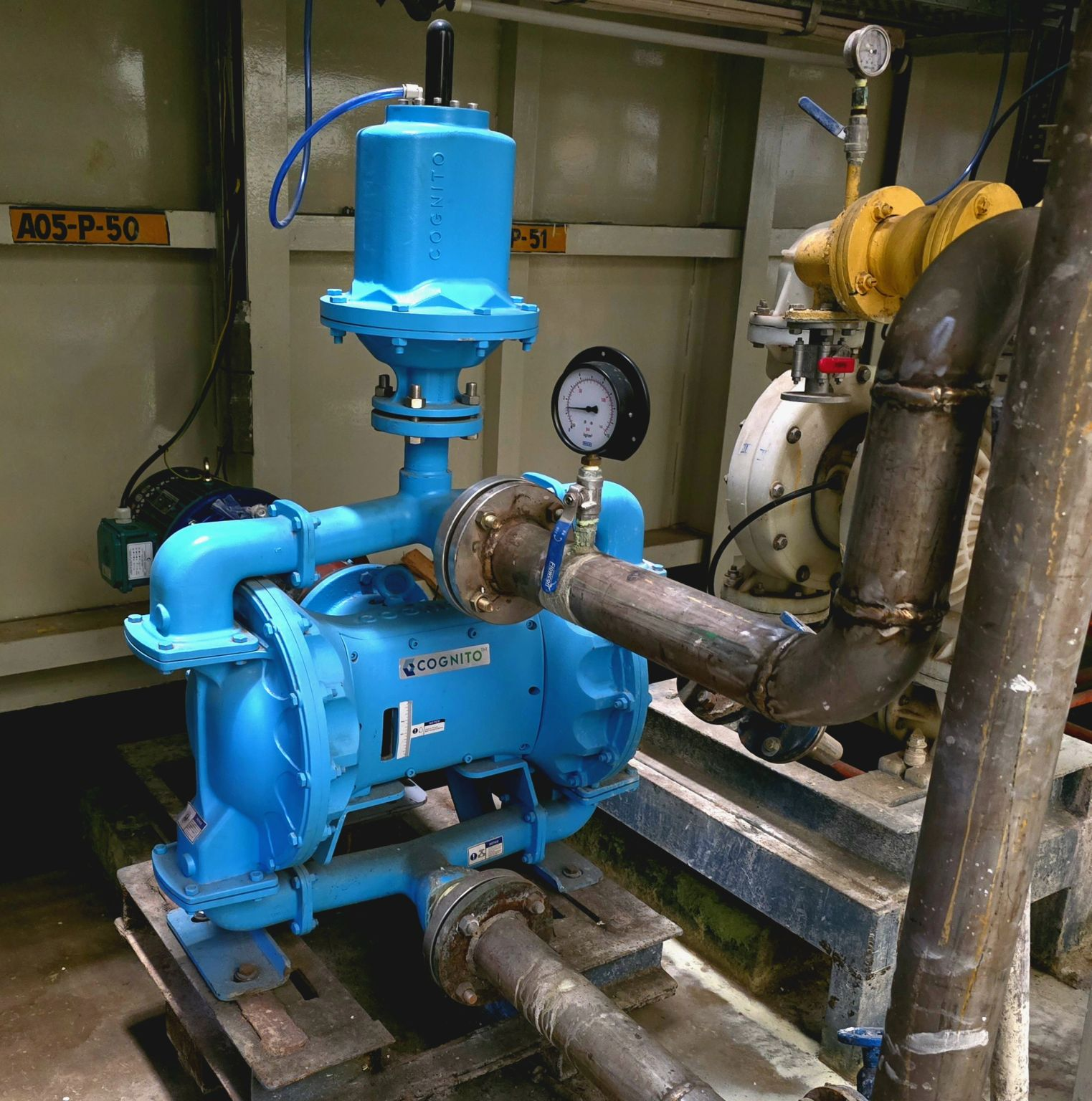
An electric double diaphragm pump, also referred to as an EODD pump, uses a motor-driven mechanism to reciprocate diaphragms. Fluid is moved through check valves without rotating seals in the fluid path.
This sealless design fundamentally changes the operational profile.
Sealless Construction
Because an industrial diaphragm pump does not rely on mechanical seals in contact with the fluid, leakage risk is significantly reduced. This lowers safety exposure and minimizes seal-related maintenance.
Ability to Run Dry
EODD pumps can run dry without damaging the pump or the system. This provides flexibility during tank emptying, startup, or upset conditions.
Solids and Abrasive Handling
Open fluid paths and hardened internal components allow EODD pumps to handle slurries, solids, and abrasive media more effectively than many rotating technologies.
Energy Efficiency
Compared to pneumatic diaphragm pumps, electric-driven EODD technology can reduce energy consumption substantially. This makes them a strong option among energy-efficient pumps, especially in facilities focused on carbon reduction and utility cost control.
Long Duty-Cycle Applications
In industries such as ceramics, chemicals, coatings, and pulp and paper, pumps often operate for extended shifts. EODD pumps are well-suited for these environments.
Head-to-Head Comparison: Operational Demand by Pump Type
Legend:
🟡 = Moderate
🔴 = Higher Risk / Higher Demand
🟢 = Lower Demand / Advantage
⚠️ = Limitation
✔️ = Strong Capability
|
Operational Factor
|
Gear Pump
|
Lobe Pump
|
EODD Pump
|
|
Energy Efficiency
|
🟡 Moderate. Can decline with wear.
|
🟡 Moderate. Depends on tolerances and conditions.
|
🟢 High efficiency with electric drive.
|
|
Maintenance Load
|
🔴 Regular seal and gear wear intervention required.
|
🔴 Seal replacement, alignment, and lobe wear management.
|
🟢 Defined diaphragm and valve intervals. No mechanical seals.
|
|
Dry Run Capability
|
⚠️ Not recommended. Risk of internal damage.
|
⚠️ Not recommended. Seal damage likely.
|
✔️ Can run dry without pump damage.
|
|
Solids & Abrasives Handling
|
⚠️ Limited tolerance. Accelerated wear possible.
|
⚠️ Limited tolerance. Seal and lobe wear common.
|
✔️ Designed to handle solids, slurries, and abrasive fluids.
|
|
Leakage Risk
|
🔴 Mechanical seals introduce leakage risk.
|
🔴 Mechanical seals introduce leakage risk.
|
🟢 Sealless fluid path reduces exposure risk.
|
|
Lifecycle Cost Impact
|
🟡 Can increase due to wear and seal maintenance.
|
🔴 Higher initial cost and seal-related maintenance.
|
🟢 Often lower lifecycle cost with reduced energy use and simplified maintenance.
|
Choosing the Lowest-Demand Pump for Your Application
Before selecting a pump technology, ask:
- Does the fluid contain solids or abrasives?
- Is dry running possible during normal operation?
- How many hours per day will the pump operate?
- What is the annual energy budget for this process?
- What are the consequences of leakage?
- How much maintenance labor is available?
Matching the pump to real operating conditions is critical. Minimizing operational demand reduces downtime, lowers lifecycle cost, and supports safety and sustainability objectives.
Why EODD Pumps Place the Lowest Operational Demand on Modern Systems
Operational demand is not defined by flow rate alone. It is shaped by energy consumption, maintenance frequency, downtime risk, system complexity, and leakage exposure.
Gear pumps offer precision for clean fluids, but wear with abrasives and solids. Lobe pumps provide gentle handling but require seals and careful maintenance. In many demanding industrial environments, these factors increase system burden over time.
Electric-operated double-diaphragm pumps offer a sealless, energy-efficient, and robust alternative. Their ability to run dry, handle solids, and reduce seal-related failures often translates into lower total cost of ownership.
To learn more about how EODD technology can reduce operational demand in your facility, schedule a 60-minute virtual training session with our team.
Pump specifications may vary by region. Please contact your local sales team for more information.